The purpose of this article is to distinguish the difference between Microvellum's Global Variables versus its Project Wizard.
The Project Wizard is composed of variables that typically fluctuate and are often changed from project to project. The Global Variables points to values of the Project Wizard to get its instructions. In the Global, if a variable has red text, this indicates that it is a Wizard Variable. You will not have access to alter these variables in the Global, as changing the value will break the link to the Wizard. However, the value of these variables can be overwritten under User Preferences in the Global if you do not plan on using the Project Wizard.
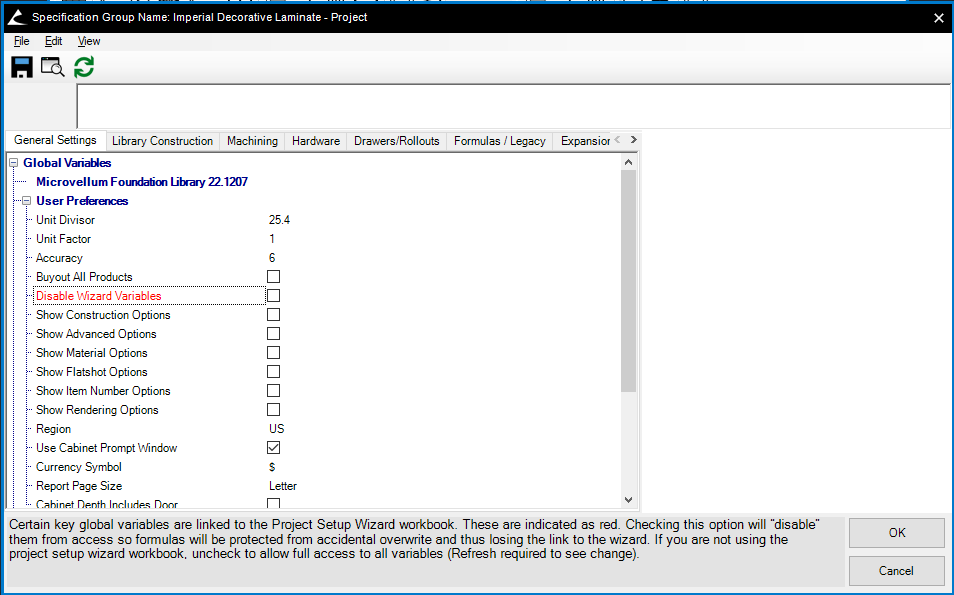
Global Variables
The Global File contains an exhaustive list of all the variables for a specification group.
A search and LookUpTable feature are available for quick access to a known variable.
The Project Wizard is a shorter list of variables that often change from job to job.
It has a lightweight user interface that is easier to navigate for beginner users than the Global.
The spreadsheet of the Wizard is nearly identical to the Product Prompt's spreadsheet.
This video demonstrates the use of the Component Library. Please note that if you are using the Foundation Library, the interfaces and features may appear different. However, the underlying concepts remain the same.
To begin modifying the components tied to a specification group collection, you must select a specification group collection first, indicated by the green checkmark. By clicking on the icons directly above the left section, you can modify the ...
The purpose of this article is to provide insight of the Global Variables when interacting inside the Toolbox Interface. How to Access the Global Variables With Toolbox open, click "Toolbox Setup > Project Specification Groups." Select the desired ...
This article summarizes the Project Wizard, Global Variables, Material Files, and Door Wizard Interfaces within the Library Specification Groups. For a general understanding of Library Specification Groups, see: Understanding the Library ...
This article summarizes the Project Specification Groups User Interface. For specific information regarding an aspect of Library Specification Groups, see one of the following articles: Understanding the Project Wizard, Global Variables, Material ...
This article summarizes the Library Specification Groups User Interface. For specific information regarding an aspect of Library Specification Groups, see one of the following articles: Understanding the Project Wizard, Global Variables, Material ...
The following release notes apply to the Microvellum Foundation Library build 26.0527. Additions Added new features for the Wood Drawer Box to have reduced sides, sub front, or back. Added 3 new global and subassembly prompts: “Wood Drawer Side ...
The following release notes apply to Microvellum build 26.1.0529.641. BSB Docking Size Fix An issue was reported to be occurring in Microvellum BSB 2026: when adjusting the size of a docked Microvellum palette, users found that the palette would ...
Hinges and mounting plates are classified as hardware items within the Foundation library, and as such, the process for adding hinges and mounting plates does not differ greatly from other pieces of hardware, though with the variety of cabinet ...
The Apply Render Materials interface is a Microvellum function that allows one to assign specific render materials to database materials within one’s material library. Using this interface, one can efficiently control and visually align one’s ...
The following release notes apply to Microvellum build 26.1.0520.641. Assign Render Material A new option has been added to the Library Specification Groups interface: Assign Render Material. This new interface displays the Microvellum material ...