POLYGON Command

POLYGON Command

Creates an equilateral closed polyline. 

You specify the number of sides of the polygon and whether it is inscribed or circumscribed. 

The following prompts are displayed: 

Number of Sides
Specifies the number of sides in the polygon (3-1024). 
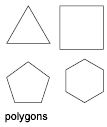
Center of Polygon

Specifies the location of the center of the polygon and whether the new object is inscribed or circumscribed. 

Inscribed in Circle
Specifies the radius of a circle on which all vertices of the polygon lie. 
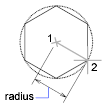
Specifying the radius with your pointing device determines the rotation and size of the polygon. Specifying the radius with a value draws the bottom edge of the polygon at the current snap rotation angle. 
Circumscribed About Circle
Specifies the distance from the center of the polygon to the midpoints of the edges of the polygon. 
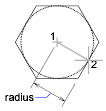
Specifying the radius with your pointing device determines the rotation and size of the polygon. Specifying the radius with a value draws the bottom edge of the polygon at the current snap rotation angle. 
Edge
Defines a polygon by specifying the endpoints of the first edge. 

Powered by AutoCAD®


    • Related Articles

    • 3DMESH Command

      Creates a free-form polygon mesh.  The mesh density controls the number of facets, and is defined in terms of a matrix of M and N vertices, similar to a grid consisting of columns and rows. 3DMESH is a legacy method for creating mesh, designed ...
    • EDGESURF Command

      Creates a mesh between four contiguous edges or curves.  Select four adjoining edges that define the mesh. The edges can be lines, arcs, splines, or open polylines. The edges must touch at their endpoints to form a single, closed loop.  You can ...
    • STRETCH Command

      Stretches objects crossed by a selection window or polygon.  Objects that are partially enclosed by a crossing window are stretched. Objects that are completely enclosed within the crossing window, or that are selected individually, are moved rather ...
    • REVSURF Command

      Creates a mesh by revolving a profile about an axis.  Select a line, arc, circle, or 2D or 3D polyline to sweep in a circular path around a selected axis.  The MESHTYPE system variable sets which type of mesh is created. Mesh objects are created by ...
    • REVCLOUD Command

      Creates or modifies a revision cloud.  You can create a new revision cloud by selecting two corner points or polygonal points, dragging your cursor, or you can convert an object such as a circle, polyline, spline, or an ellipse into a revision cloud. ...
    • Recent Articles

    • Microvellum Release Notes | Build 26.1.0422.641

      The following release notes apply to Microvellum build 26.1.0422.641. BSB 2026 Microvellum BSB 2026 is now available for download and installation by users with an existing Microvellum BSB subscription. This new version of Microvellum is based on ...
    • Microvellum BSB 2026

      Microvellum BSB 2026 is now available for purchase and download. BSB 2026 introduces the Microvellum software bundled together with the BricsCAD Pro 2026 platform, with all of the accompanying changes and enhancements made after BricsCAD 2025. With ...
    • Microvellum Release Notes | Build 25.2.0406.641

      The following release notes apply to Microvellum build 25.2.0406.641. Label Image Fix Fig. 1: An error noting an incorrect number of Label Images. An issue was reported wherein creating new G-code from an existing work order that was edited using ...
    • Microvellum Foundation Library Release Notes | Build 26.0327

      The following release notes apply to Microvellum Foundation Library build 26.0327. Additions Added new Formula Driven Materials (FDM) and accompanying special FDM project wizard. * New Specification Group “Wizard Formula Driven Materials [FDM]”. New ...
    • Formula Driven Materials (FDM) User Guide

      The formula driven material (FDM) system in Microvellum automates the creation and management of materials within a project. By using predefined lookup tables and intelligent formulas, FDM dynamically generates each material’s name, thickness, and ...