Understanding the Workbook Designer Interface

Understanding the Workbook Designer Interface

Workbook Designer Interface

Workbook Designer contains more tools than the Edit Design Data interface. However, some of the advanced features of Edit Design Data are not available when working through Workbook Designer. The automatic formatting of turning cells that contain formulas to red text is not available, nor is the ability to quickly add defined names as it was with Edit Design Data.
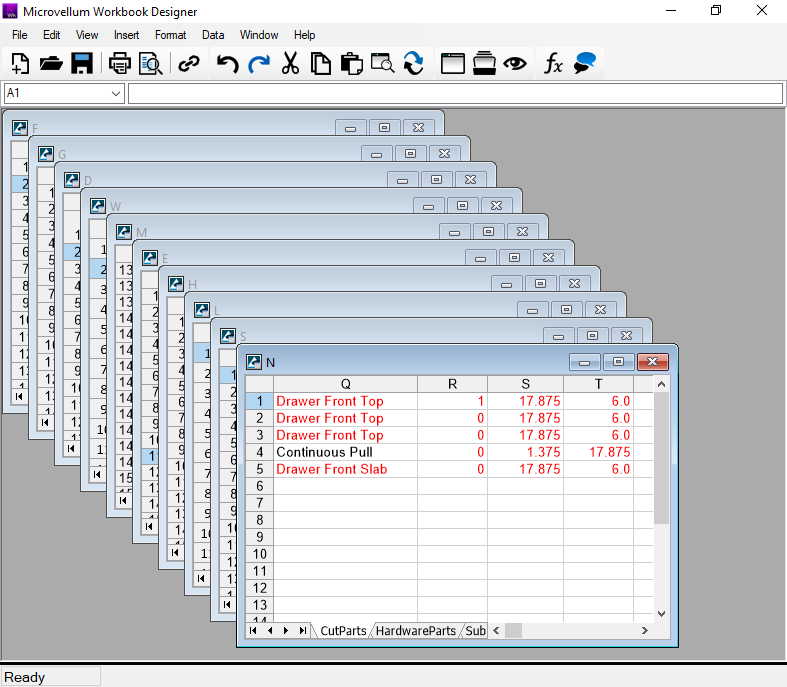
  1. New – Allows you to add a new workbook.
  2. Open – Allows you to open a workbook saved to the disk.
  3. Save – Allows you to save the changes made to the workbook.
  4. Print – Allows you to print the current tab of the open workbook.
  5. Print Preview – Allows you to preview the current tab before printing.
  6. Set Microvellum Title – Allows you to set the name of the workbook to the Microvellum title (G, W, L, S, etc.)
  7. Undo – Allows you to undo changes.
  8. Redo – Allows you to redo changes that were undone.
  9. Cut – Allows you to cut a cell, or range of cells, from the worksheet.
  10. Copy – Allows you to copy a cell, or range of cells, from the worksheet.
  11. Paste – Allows you to paste a cut or copied cell, or range of cells, to another location.
  12. Find – Allows you to find a text string within the worksheet, workbook, or workbooks.
  13. Replace – Allows you to find a text string and replace it with something different within the worksheet, workbook, or workbooks.
  14. Show Workbook Explorer – Allows you to access Workbook Explorer, which can be used to perform additional formatting, adding additional worksheets, and accessing the page setup.
  15. Name Manager – Allows you to access the Name Manager, which displays all the defined names and ranges within the current workbook. This tool can be used to add, edit, or delete defined names. It can also be used to find overlapping defined names.
  16. Show Watch Window – Allows you to add cells from other worksheets or workbooks, so they can be monitored when making changes to other variables that would affect the cells being watched.
  17. Insert Function – Allows you to access the Formula Editor.
  18. Add Comment – Allows you to add a comment to a cell.

    • Related Articles

    • A Look into Workbook Designer and the Different Workbooks

      A Look into Workbook Designer and the Different Workbooks The Workbook Designer interface will be covered in more detail in a later section. However, this section will briefly cover Workbook Designer to understand the different workbooks and ...
    • Understanding the Edit Design Data Interface

      The Edit Design Data interface is a spreadsheet editor, similar to Microsoft Excel.  The interface includes tools located at the top of the window. Below the tool icons is a drop-down list of defined names that can be used to locate the cell’s ...
    • Overview of Workbook Designer

      The purpose of this article is to provide an overview of the Workbook Designer feature. How to Access the Workbook Designer The most commonly used method for accessing Workbook Designer is through the Edit Design Data feature, which can be accessed ...
    • Introduction to the Global Workbook

      The Global Workbook can be accessed through the Workbook Designer interface and is labeled as the “G” workbook. All Global Variable information in the correct workbook location is visible and available to edit in the Global Variable user interface ...
    • Overview: Passing Prompt Information Between Workbooks (Subassembly)

      We have added the ability to pass custom information from the L! workbook (local prompts) to the S! workbook (subassemblies). Without that ability, the number of prompts is greater, and the complexity of formulas increases. When the formula ...
    • Recent Articles

    • Toolbox Release Notes | Build 25.1.1204.641

      The following release notes apply to Toolbox build 25.1.1204.641 Toolbox Login Screen Update Fig. 1: The updated Toolbox Login interface. The Toolbox Login interface has had several changes applied to it to enhance its usability and allow for greater ...
    • Toolbox Release Notes | Build 25.1.1120.641

      The following release notes apply to Toolbox build 25.1.1120.641 Mouse Wheel Fix There was a reported issue in certain interfaces (such as report groups) in which hovering over a dropdown menu (such as Output Type) would result in the options within ...
    • Dynamic Dimensioning in Toolbox BSB

      When applying dimensions to products and other solids in Toolbox BSB, by default, all dimensions are drawn in 2D on the Y plane, requiring one to switch to a top view (or an appropriately high isometric view) to see them. BricsCAD has a feature that ...
    • Toolbox Release Notes | Build 25.1.1107.641

      The following release notes apply to Toolbox build 25.1.1107.641. Subassembly Prompt Fixes A pair of issues were reportedly occurring when attempting to work with subassembly prompts in the Edit Design Data interface. Subassemblies copied to the ...
    • Microvellum Foundation Library Release Notes | Build 25.1024

      The following release notes apply to the Microvellum Foundation Library build 25.1024. Additions Added Face Profile Options to the Door Wizard for enhanced design flexibility. Users can now apply decorative visual profiles to doors, drawer fronts, ...