STRETCH Command

STRETCH Command

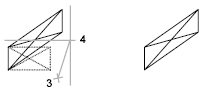
Stretches objects crossed by a selection window or polygon. 

Objects that are partially enclosed by a crossing window are stretched. Objects that are completely enclosed within the crossing window, or that are selected individually, are moved rather than stretched. 


The following prompts are displayed: 
Select Objects
Specifies the portion of the object that you want to stretch. Use the cpolygon option or the crossing object selection method. Press Etner when the selection is complete. 

STRETCH moves only the vertices and endpoints that lie inside the crossing selection, leaving those outside unchanged. STRETCH does not modify 3D solids, polyline width, tangent, or curve-fitting information. 
Base Point

Specifies the base point from which the offset for the stretch is calculated. This base point can be outside the area being stretched. 

Second Point
Specifies a second point that defines the distance and direction of the stretch. The distance and direction of this point from the base point defines how far and in what direction the selected portions of the object will be stretched. 
Use First Point as Displacement
Specifies that the stretch distance and direction will be based on the distance and direction of the base point you specified from the 0, 0, 0 coordinates in the drawing. 
Displacement 
Specifies the relative distance and direction of the stretch. 
  1. To set a displacement based on the relative distance from the current location, enter distances in X, Y, Z format. For example, enter 5, 4, 0 to stretch the selection to a point that is 5 units along the X axis and 4 units along the Y axis from the original point. 
  2. To set the displacement based on the distance and direction from the 0, 0, 0 coordinates in the drawing, click a location in the drawing area. For example, click a point at 1, 2, 0 to stretch the selection to a point that is 1 unit along the X axis and 2 units along the Y axis from its current location. 

Powered by AutoCAD®


    • Related Articles

    • 3DMOVE Command

      In a 3D view, displays the 3D Move gizmo to aid in moving 3D objects a specified distance in a specified direction.  With the 3D Move gizmo, you can move selected objects and sub-objects freely or constrain the movement to an axis or plane.  If the ...
    • AutoCAD Keyboard Commands

      Learning how to use AutoCAD keyboard commands can help you work faster and improve your efficiency. This article lists the abbreviated commands that can be used in AutoCAD (Toolbox). Toggle General Features Ctrl+G Toggle Grid Ctrl+E Cycle isometric ...
    • Microvellum Commands vs AutoCAD Commands

      Toolbox, as an OEM based on AutoCAD, possesses the full range of AutoCAD commands for use in accessing AutoCAD functions, such as drawing shapes, opening menus, altering the dimensions of polylines, etc. However, it should be noted that when working ...
    • Basic 2D Commands

      Basic 2D Commands To execute an AutoCAD command, type the command (or quick-key) in the command line. The command line is located at the bottom of the drawing area. Some commands require additional steps, or subcommands, the next step for the command ...
    • 3DPOLY Command

      Creates a 3D polyline.  A 3D polyline is a connected sequence of straight line segments created as a single object. 3D polylines can be non-coplanar; however, they cannot include arc segments.  The following prompts are displayed:  Start Point of ...
    • Recent Articles

    • Toolbox Release Notes | Build 25.1.1204.641

      The following release notes apply to Toolbox build 25.1.1204.641 Toolbox Login Screen Update Fig. 1: The updated Toolbox Login interface. The Toolbox Login interface has had several changes applied to it to enhance its usability and allow for greater ...
    • Toolbox Release Notes | Build 25.1.1120.641

      The following release notes apply to Toolbox build 25.1.1120.641 Mouse Wheel Fix There was a reported issue in certain interfaces (such as report groups) in which hovering over a dropdown menu (such as Output Type) would result in the options within ...
    • Dynamic Dimensioning in Toolbox BSB

      When applying dimensions to products and other solids in Toolbox BSB, by default, all dimensions are drawn in 2D on the Y plane, requiring one to switch to a top view (or an appropriately high isometric view) to see them. BricsCAD has a feature that ...
    • Toolbox Release Notes | Build 25.1.1107.641

      The following release notes apply to Toolbox build 25.1.1107.641. Subassembly Prompt Fixes A pair of issues were reportedly occurring when attempting to work with subassembly prompts in the Edit Design Data interface. Subassemblies copied to the ...
    • Microvellum Foundation Library Release Notes | Build 25.1024

      The following release notes apply to the Microvellum Foundation Library build 25.1024. Additions Added Face Profile Options to the Door Wizard for enhanced design flexibility. Users can now apply decorative visual profiles to doors, drawer fronts, ...