Configuration Editor: Machining Options

Configuration Editor: Machining Options

This article provides an overview of the options and settings available on the Machining tab of the Configuration Editor (Options) Interface.  For a complete list of available tabs and options visit Overview: Configuration Editor (Options) Interface.

The machining tab contains settings that apply when you create G-Code for a CNC machine. The settings range from setting the current drawing tool file you want to use and accessing the tool file to change additional options with G-Code generation. 


Single Part Drawings

Parts processed with a Single Part G-code station can generate a drawing into a drawing file just like a nest. Processing parts using a single part g-code station creates a parts.dwg file in the material folder of the corresponding work order. The option selected from the single part drawings settings will determine the creation method of the parts drawings.
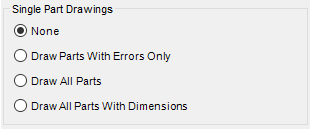

None  – No parts are drawn into the parts.dwg file.

Draw Parts with Errors Only  – Draws only parts with errors in their G-Code into the parts.dwg file.

Draw All Parts  – Draws all parts into the parts.dwg file.

Draw All Parts with Dimensions – Draws all parts into the parts.dwg file with the dimensions set in the  Dimension Settings  button, dimension the overall part size, routing, sawing, vertical drilling, and horizontal drilling machining operations.

G-Code File Naming Convention

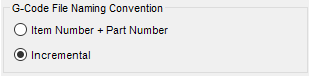
Item Number + Part Number – This naming convention generates more descriptive G-Code file names, but increases the chance for duplicate file names.

Incremental – This naming convention generates a random file name single part G-Code files and ensures that the program creates unique file names.

WMF, DXF Settings

WMF Settings – Properties that control the dimensions for overall part size, routing, sawing, vertical drilling, and horizontal drilling machining operations.

DXF Settings – Properties that determine and control how the dimension styles present within a DXF file apply in routing, sawing, vertical drilling, and horizontal drilling machining operations. Changes in dimensions must be made within the DXF template.

Path to DXF Template – Click browse to select the path to the file folder wherein one's DXF template is stored. 


G-Code File Name Options

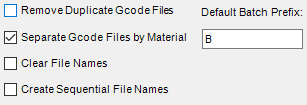
Remove Duplicate G-Code Files – Compares each G-Code file created for duplicate files. If the program encounters a duplicate G-Code file, all references within the database will match the original file. Removing duplicate G-Code files reduces redundancy and allows a single program for identical parts.

Separate G-Code Files by Material  – Creates the G-Code files for nests and single parts in separate folders based on material.

Clear File Names – Clears the default program functionality of assigning file names that match the data specified in the cut parts file, column N, if data exists there. If this checkbox is checked, the program will apply the names specified in the cut parts file. If it is cleared, the program will apply random file names.

Create Sequential File Names – Causes the program to assign file names sequentially instead of randomly.

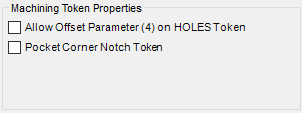
Machining Token Properties

Controls specific machining token properties.

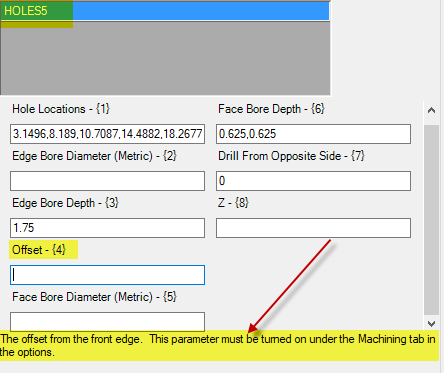
Allow Offset Parameter (4) on HOLES Token -  enables parameter (4) of the Holes Token (see Fig. 31)

Pocket Corner Notch Token -  sets pocketing for corner notch instead of a cutout.


    • Related Articles

    • Configuration Editor: Processing Options

      This article provides an overview of the options and settings available on the Processing tab of the Configuration Editor (Options) Interface. For a complete list of available tabs and options visit Overview: Configuration Editor (Options) Interface. ...
    • Overview: Configuration Editor (Options) Interface

      The Configuration Editor (Options) Interface for Microvellum Toolbox is accessible from the Toolbox Setup menu. Using the options contained within, you'll configure general system settings, set up the optimization software you use, set up tool files, ...
    • Configuration Editor: Solid Analyzation Options

      This article provides an overview of the options and settings available on the Solid Analyzation tab of the Configuration Editor (Options) Interface. For a complete list of available tabs and options visit Overview: Configuration Editor (Options) ...
    • Configuration Editor: General Options

      This article provides an overview of the options and settings available on the General tab of the Configuration Editor (Options) Interface. For a complete list of available tabs and options visit Overview: Configuration Editor (Options) Interface. ...
    • Configuration Editor: CAD Options

      This article provides an overview of the options and settings available on the CAD tab of the Configuration Editor (Options) Interface. For a complete list of available tabs and options visit Overview: Configuration Editor (Options) Interface. ...
    • Recent Articles

    • Microvellum Foundation Library Release Notes | Build 26.0527

      The following release notes apply to the Microvellum Foundation Library build 26.0527. Additions Added new features for the Wood Drawer Box to have reduced sides, sub front, or back. Added 3 new global and subassembly prompts: “Wood Drawer Side ...
    • Microvellum Release Notes | Build 26.1.0529.641

      The following release notes apply to Microvellum build 26.1.0529.641. BSB Docking Size Fix An issue was reported to be occurring in Microvellum BSB 2026: when adjusting the size of a docked Microvellum palette, users found that the palette would ...
    • Adding Custom Hinges and Mounting Plates (Foundation Library)

      Hinges and mounting plates are classified as hardware items within the Foundation library, and as such, the process for adding hinges and mounting plates does not differ greatly from other pieces of hardware, though with the variety of cabinet ...
    • Apply Render Materials

      The Apply Render Materials interface is a Microvellum function that allows one to assign specific render materials to database materials within one’s material library. Using this interface, one can efficiently control and visually align one’s ...
    • Microvellum Release Notes | Build 26.1.0520.641

      The following release notes apply to Microvellum build 26.1.0520.641. Assign Render Material A new option has been added to the Library Specification Groups interface: Assign Render Material. This new interface displays the Microvellum material ...